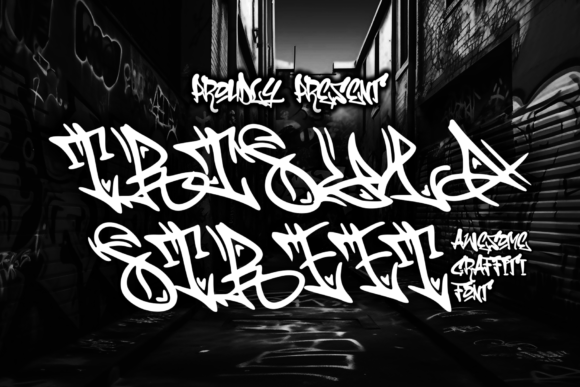
Trisula Street Font: Urban Elegance for Handmade Labels & Printables
If you’ve ever held a hand-poured candle, flipped through a boutique wedding invitation suite, or admired the clean-yet-characterful typography on a small-batch coffee bag—you know how much a single font can shape perception. Trisula Street is that kind of font: a monoline graffiti-inspired script from the Script Amp collection that balances raw urban energy with refined readability. It’s not just “edgy”—it’s intentional, fluid, and surprisingly versatile for crafters who need beauty *and* function.
What makes Trisula Street stand out isn’t just its graffiti roots—it’s how those roots translate into real-world product use. The strokes are consistent in weight (monoline), so it cuts cleanly on Cricut and Silhouette machines, holds detail at 12–16 pt on printed tags and stickers, and scales beautifully from tiny jar labels to large-format wall art. There’s no heavy contrast or dramatic flourishes that collapse when resized—just confident, rhythmic letterforms with subtle bounce and natural spacing. That means your “Small Batch • Hand-Poured” candle label reads as artisanal, not amateurish. Your “Welcome to Our Farmhouse” sign feels grounded, not chaotic.
For printable creators and stationery designers, Trisula Street shines in high-demand categories: wedding welcome boards, birthday party invitations, baby shower banners, and boutique gift tags. Its balanced flow gives names and short phrases—like “The Smiths,” “Est. 2023,” or “Made With Love”—a warm, human rhythm without sacrificing clarity. I’ve used it for digital planner covers where clients want personality but still need to scan headings quickly—and it delivers. On physical products like ceramic mugs or linen tote bags, it adds texture and story without competing with the material itself.
Readability matters most when your font lives in the wild—not just on screen. Trisula Street performs well across formats: it renders crisply in PDF printables, stays legible on matte sticker paper (even at ⅜”), and previews cleanly in Etsy mockups. For cutting machines, I recommend using the OTF version with basic OpenType features enabled—no swashes or ligatures needed for standard product text, but they’re there if you want to elevate a special title or monogram. Check the file package: Trisula Street includes uppercase, lowercase, numerals, punctuation, and multilingual support for common Western European languages—essential if you sell globally or design bilingual packaging.
Pairing Trisula Street thoughtfully expands its range. Use it as your expressive anchor, then ground it with a clean sans serif like Montserrat or Poppins for body text, ingredient lists, or care instructions. That combo works perfectly on soap labels, recipe cards, or digital workshop workbooks. For vintage-leaning projects—think apothecary jars or holiday market signage—try pairing it with a gentle serif like Playfair Display or Lora. Avoid stacking two highly decorative fonts; Trisula Street carries enough presence on its own. When designing SVG files for layered vinyl decals, keep Trisula Street for top-line impact (“Freshly Baked”) and switch to a geometric sans for secondary info (“Mon–Sat • 8am–4pm”).
Real examples from my own shop show how flexible it is: a set of printable “Thank You” cards for local florists used Trisula Street for the sentiment and a light sans for the business name—customers said it felt “thoughtful but never fussy.” A line of seasonal soy wax melts featured Trisula Street on front labels (“Spiced Orange • Fall 2024”) and a minimalist sans on back labels listing burn time and safety notes. Even a batch of embroidered tea towel patterns used Trisula Street for the stitched phrase “Brew Slowly”—digitized cleanly, with no stitch distortion.
Here’s what I always check before committing Trisula Street to a product line: first, test it at actual size on the intended medium. Print a 1” x 2” sticker mockup. Cut a ¾” tag on your machine. Preview how it looks next to your logo or brand colors. Second, verify licensing. Trisula Street is a commercial font—meaning you *can* use it on physical goods you sell (candles, shirts, stickers), in digital templates (Canva-compatible planners, Procreate brushes), and in client work—but always review the license terms. Most Script Amp fonts allow unlimited commercial use for physical products and digital downloads, including SVG designs and printable bundles, as long as you’re not reselling the font file itself.
It’s also worth noting where Trisula Street *isn’t* ideal—so you save time and testing. Don’t use it for dense paragraphs, ingredient tables, or legal disclaimers. It’s a display font, not a text face. Skip it for ultra-minimalist branding that leans into stark geometry, or for formal corporate stationery that requires traditional calligraphy. But within its sweet spot—short, evocative, emotionally resonant text—it builds instant recognition. Customers begin to associate that smooth, confident rhythm with your brand’s authenticity, whether they see it on a sticker, a mug, or a social media graphic.
Ultimately, Trisula Street works because it respects both the craft and the customer. It doesn’t shout—it invites. It doesn’t overwhelm—it complements. And for makers who pour heart into every label, card, and printable, having a font that does that *consistently*, across mediums and seasons, is rare. Whether you’re launching your first Etsy shop or refreshing a five-year-old product line, Trisula Street is the kind of typeface that helps your handmade details feel intentional, memorable, and quietly professional.